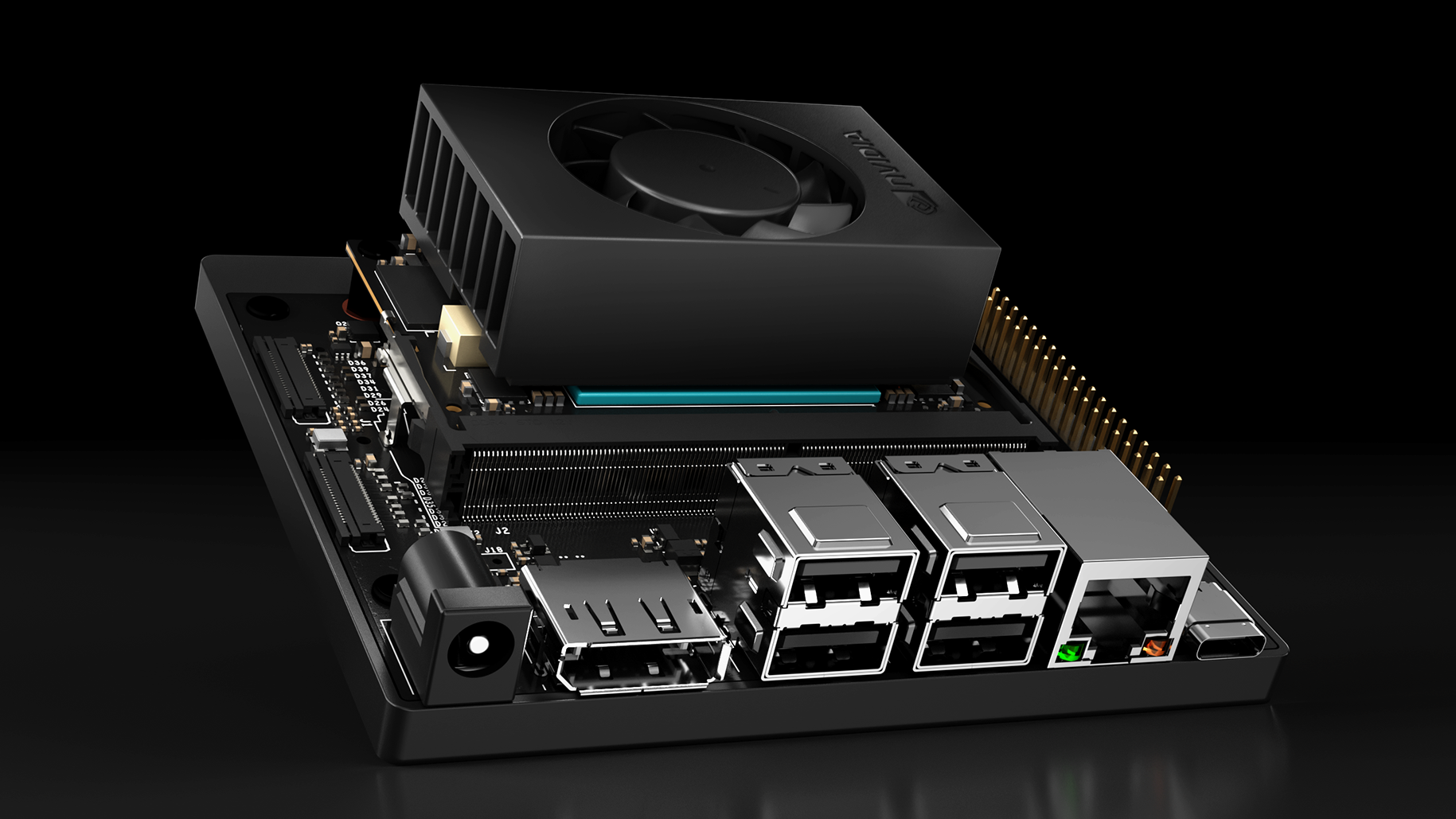
Embedded AI that runs on the device, not in the cloud.
A1SI builds embedded-AI systems on the NVIDIA Jetson Orin lineup — Orin Nano Super, Orin NX, Orin AGX — delivering up to 275 TOPS of on-device inference for computer vision, conversational LLMs, multimodal sensor fusion, and ML-driven control. The reference deployment is A1 Home Manager, our edge-AI smart-home appliance: Frigate NVR with GPU-accelerated object detection, Home Assistant Assist with a local LLM doing wake-word → intent → response with no cloud round-trip, Ollama Vision for multimodal image understanding, ML energy optimization, and AI presence detection that fuses Bluetooth + UWB + camera + mmWave radar — all running on a Jetson Orin Nano Super in the home, off-grid capable. From TinyML on a Cortex-M MCU to a data-center-class GPU on a system-on-module the size of a credit card.
Edge-AI workloads span four orders of magnitude in compute — from a quantized keyword-spotter on a $5 microcontroller to a multimodal LLM on a 275-TOPS Jetson AGX. A1SI engineers across the whole range so the architecture decision (which tier, which model size, which quantization) comes out of measured trade-offs against the latency, power, and accuracy envelope.
NVIDIA Jetson Orin platform engineering
JetPack 6 on Orin Nano Super (67 TOPS), Orin NX (100 TOPS), and Orin AGX (275 TOPS). CUDA 12, TensorRT engine builds, DeepStream for multi-camera pipelines, NVIDIA Triton Inference Server for model serving, custom L4T kernel modules where the application needs them. The platform A1 Home Manager ships on.
Local LLMs (Ollama, llama.cpp, vLLM)
On-device large-language-model deployment: Llama 3.1 / 3.2, Mistral 7B, Phi-3, Qwen 2.5, multimodal Llava and MiniCPM-V. Ollama for the productized stack, llama.cpp for embedded targets, vLLM for higher-throughput serving on Orin AGX. Quantization (Q4_K_M, AWQ, GPTQ) and KV-cache discipline so the model fits the on-module memory budget.
Computer vision + NVR
Real-time object detection (YOLOv8 / YOLOv9 / RT-DETR), pose estimation, OCR, and scene understanding accelerated through TensorRT engines. Frigate NVR integration for whole-home multi-camera workflows (the deployment A1 Home Manager ships), GStreamer-based capture pipelines, and on-device video analytics with no cloud round-trip.
TinyML on MCUs
Quantized keyword spotting, vibration anomaly detection, and gesture recognition on Cortex-M0+ through Cortex-M85 silicon (ESP32-S3, Nordic nRF52840, STM32H7, Raspberry Pi RP2040). Edge Impulse + TensorFlow Lite for Microcontrollers + CMSIS-NN, models sized to fit in 100–500 KB of flash with sub-100 ms inference budgets.
Multimodal sensor fusion
Camera + mmWave radar + LiDAR + IMU + audio fused through learned models for real-time scene understanding. Presence detection, gesture inference, vehicle and pedestrian tracking, and acoustic-event classification. The fusion stack inside A1 Home Manager — Bluetooth + UWB + camera + mmWave — productized across the embedded-AI service line.
Agentic AI + tool use
LangGraph / LangChain agents with structured tool use, retrieval-augmented generation against on-device vector stores (Chroma, sqlite-vec), the Model Context Protocol (MCP) for tool-call serialization, and ROS 2 integration for robotics. Local-first reasoning that calls real APIs and real device controls — no cloud-only dependency.
How we engage
Five steps from accuracy budget to production deployment.
Edge-AI work fails most often at the architecture step — a model that hits the accuracy target on a workstation GPU and then falls apart against the latency and power budget on the device. We organize every program around the same five-step flow so the budget conversation happens at step 1, not at step 4.
1
Accuracy + latency + power budget
Use-case accuracy target, end-to-end latency envelope, power and thermal budget, deployment tier (MCU / Jetson Nano / Jetson NX / Jetson AGX). The artifact: a written budget document with measurable success criteria, so model-selection trade-offs are made against numbers, not vibes.
2
Model + dataset selection
Pretrained-model survey against the budget (open-weights LLMs, YOLO variants, Whisper, custom-trained vision backbones). Dataset curation, labeling tools, train / val / test split discipline. The artifact: a baseline model with documented accuracy on the held-out set and a clear improvement path.
3
On-device deployment + optimization
TensorRT engine build with FP16 / INT8 / mixed-precision calibration, quantization (Q4_K_M for LLMs, INT8 for CV), knowledge distillation where the budget needs it, ONNX export for portability. The artifact: an on-device inference engine that hits the latency budget with the accuracy budget intact.
4
Bring-up + on-device validation
End-to-end on-device pipeline (sensor → preprocessor → inference → postprocessor → consumer), latency and throughput profiling under realistic load, thermal soak test, accuracy regression against the held-out test set on the device itself (not just the workstation). The artifact: a validation report against the step-1 budget.
5
Production deployment + observability
Signed firmware / signed JetPack image, OTA model-update channel with rollback, on-device telemetry (model drift, accuracy regression, thermal events), Sentry-style crash and event capture, post-launch retraining cadence. The artifact: a production deployment that stays at the step-1 budget over its operational lifetime.
The bench
The edge-AI stack, vendor-neutral hand-off.
Every project uses the right tool for the deployment tier, but the artifact is portable: ONNX or a documented TensorRT engine plus the source training code, not a proprietary model bundle the next engineer can't open. If your team is invested in PyTorch, we ship PyTorch. If your CM wants the JetPack image preflashed, we ship the image. The deliverable is portable; the tool choice is pragmatic.
NVIDIA JetPack 6 + CUDA 12 + TensorRTJetPack BSP for the Orin lineup, CUDA 12.6 kernels, TensorRT 10 engine builds with FP16 / INT8 / sparsity, DeepStream 7 for multi-stream video, Triton Inference Server for model serving. The runtime A1 Home Manager ships on.
Ollama · llama.cpp · vLLMOllama for the operational LLM stack on Jetson + Home Manager, llama.cpp for tighter embedded targets and CPU-only deployments, vLLM for higher-throughput Orin AGX workloads. Quantization with GGUF, AWQ, GPTQ; KV-cache budgeting; LoRA / QLoRA fine-tuning where it earns its keep.
PyTorch · ONNX · TensorFlowPyTorch 2.x as the default training framework, ONNX as the cross-toolchain interchange format, TensorFlow / Keras where the team is already invested. Hugging Face Transformers + Datasets + Accelerate for the LLM and vision-model paths.
Edge Impulse · TF Lite Micro · CMSIS-NNEdge Impulse Studio for the TinyML training-and-deployment loop, TensorFlow Lite for Microcontrollers as the runtime, ARM CMSIS-NN as the optimized inference kernel set. Models sized to 100–500 KB of flash, sub-100 ms inference, no RTOS dependency.
Frigate · YOLOv8/v9 · DeepStreamFrigate for the productized NVR layer (the deployment A1 Home Manager ships), YOLOv8 / YOLOv9 / RT-DETR for fresh object-detection training, NVIDIA DeepStream for multi-camera pipelines on Orin NX / AGX, GStreamer for the underlying capture and transport.
LangGraph · MCP · ROS 2LangGraph + LangChain for agentic workflows, the Model Context Protocol (MCP) for portable tool serialization, Chroma + sqlite-vec for on-device vector retrieval, ROS 2 Humble / Jazzy with Isaac ROS for robotics. Local-first agentic reasoning with real API + device-control side effects.
Recent work
A1 Home Manager — the edge-AI appliance reference architecture.
A1 Home Manager — Edge-AI Smart Home Appliance
NVIDIA Jetson Orin Nano Super · 67 TOPS · 1024 CUDA · 32 Tensor · NVIDIA Ampere
A1SI's productized fork of the open-source Home Assistant platform, hardened and edge-AI-accelerated on the NVIDIA Jetson Orin Nano Super (67 TOPS of on-device AI, 1024 CUDA cores, 32 Tensor cores, NVIDIA Ampere architecture, on a system-on-module the size of a credit card). The reference deployment for everything on this service page: Frigate NVR for GPU-accelerated multi-camera object detection, Home Assistant Assist with a local LLM running wake-word → intent → response in the appliance with no cloud round-trip, Ollama Vision for multimodal image understanding (read text in an image, describe a scene, answer questions about what a camera sees), machine-learning energy optimization for high-power loads, and AI presence detection that fuses Bluetooth + UWB + camera + mmWave radar. The whole stack runs on-device, off-grid capable — no telemetry, no cloud-only intelligence, no third-party data path.
An on-device AI deployment with the regression artifacts to prove it.
Every program closes with the model artifact, the runtime engine, the deployment image, and the validation report against the step-1 budget — handed off as one reproducible release, not a model file in a Slack thread.
Platform coverage
MCU TinyML → Jetson Orin Nano / NX / AGX (up to 275 TOPS)
100% on-device · off-grid capable · no cloud round-trip
Hand-off artifacts
JetPack image · TensorRT engine · ONNX · training code
Why A1SI
Built on the same engineering posture as A1 Home Manager.
Privacy by architecture, not by setting
Edge AI means inference runs where the data lives — on the device, in the home, inside the building. Voice commands, camera feeds, telemetry never leave the appliance. The reference deployment (A1 Home Manager) runs every AI workload on the Jetson Orin Nano Super on-premise; the whole system can run completely off-grid with no internet path at all. The privacy story isn't a configuration option; it's the architecture.
Real production deployment, not a demo
A1SI ships embedded AI as production hardware: A1 Home Manager is the reference appliance, with Frigate NVR, Home Assistant Assist, Ollama Vision, energy ML, and AI presence detection all running in real homes today on real Jetson Orin Nano silicon. The lessons from that deployment — TensorRT engine builds against latency budgets, GGUF quantization against memory budgets, thermal soak under continuous load — shape every embedded-AI engagement we take on.
Open standards, vendor-neutral hand-off
PyTorch + ONNX + Hugging Face on the training side. JetPack + CUDA + TensorRT on the deployment side. Ollama + llama.cpp on the LLM side. Edge Impulse + TF Lite + CMSIS-NN on the TinyML side. Every artifact in a portable, open-standards format — your next engineer can open the model in the toolchain of their choosing, your CM can flash the JetPack image without a proprietary tool, and your team can keep the deployment running long after the engagement closes.
A1SI picks up edge-AI programs at every stage — use-case scoping, model selection, on-device optimization, bring-up and validation, production deployment, and ongoing model retraining. Send the use-case, the accuracy target, or the latency / power envelope you're stuck on; we'll come back with what we'd do next and what the engagement would look like — whether the target is a $5 microcontroller or a 275-TOPS Jetson AGX.
"NVIDIA", "Jetson", "Orin", "JetPack", "CUDA", "TensorRT", "DeepStream", "Triton Inference Server", "Isaac ROS", and "NVIDIA Ampere" are trademarks of NVIDIA Corporation. "Ollama" is a trademark of Ollama Inc. "Llama" is a trademark of Meta Platforms, Inc. "Mistral" is a trademark of Mistral AI. "Phi" is a trademark of Microsoft Corporation. "Qwen" is a trademark of Alibaba Cloud / Alibaba Group. "PyTorch" is a trademark of The Linux Foundation. "TensorFlow" and "TF Lite" are trademarks of Google LLC. "ONNX" is a trademark of the Linux Foundation / LF AI & Data. "Hugging Face" is a trademark of Hugging Face, Inc. "Edge Impulse" is a trademark of EdgeImpulse Inc. "Frigate" is a trademark of Blakeshome / the Frigate NVR project. "Home Assistant" and "Assist" are registered trademarks of the Open Home Foundation. "YOLO" / "YOLOv8" / "YOLOv9" are trademarks of Ultralytics. "LangChain" and "LangGraph" are trademarks of LangChain, Inc. "Model Context Protocol" / "MCP" is a protocol designation introduced by Anthropic PBC. "ROS" and "ROS 2" are trademarks of Open Source Robotics Foundation. "ARM" and "CMSIS" are trademarks of Arm Limited. "Cortex-M" is a trademark of Arm Limited. "ESP32" is a trademark of Espressif Systems. "STM32" is a trademark of STMicroelectronics. "Raspberry Pi" and "RP2040" are trademarks of Raspberry Pi Ltd. "Chroma" is a trademark of Chroma Inc. Edge-AI performance figures cited (67 TOPS, 1024 CUDA cores, 32 Tensor cores for Jetson Orin Nano Super; up to 275 TOPS for the Orin lineup) are NVIDIA's published Jetson specifications; workload-specific performance depends on configuration. A1 Home Manager is A1SI's independent, productized derivative built on the open-source Home Assistant platform; A1SI is not affiliated with or endorsed by the Open Home Foundation. Descriptive editorial use only; A1SI is not affiliated with or endorsed by any other named third party.