Launched Redmer Software Company (1997–2001)
EZ-SNAP was the founding product of Redmer Software Company, the predecessor business to Redmer Controls Inc. The company chronology that runs through A1SI today starts here.
Company-founding case study · 1997–2001 · Redmer Software Company
EZ-SNAP was a camera order entry system that ran on Symbol PDT handheld scanners and powered the order workflow at portrait sessions for some of the largest photographic-processing and school-picture companies in the United States — including Olan Mills, American Family Photographers, and many others. The product launched Redmer Software Company (1997–2001), the predecessor to Redmer Controls Inc. and the founding company in the lineage that ultimately became A1 Systems Integrators.
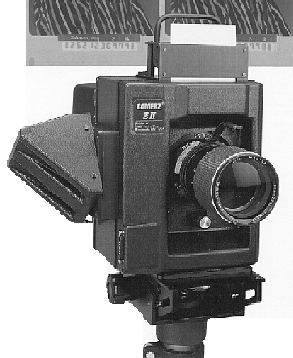
On the studio floor
EZ-SNAP ran on the Symbol PDT 3100 handheld scanners that portrait photographers and lab operators carried at the studio. At each roll setup the operator scanned the session context once — customer, photographer, lights, camera, twin-check, magazine, work type, job — and then, as each subject sat for the camera, scanned the subject card plus the product codes for their package, and EZ-SNAP fired the Camerz Z-II itself for the correct shot. The pre-digital photographic-processing industry ran on barcoded paper workflow; EZ-SNAP put that workflow on a handheld, wired it into the camera's trigger, and made it audit-traceable.
The company-founding moment
EZ-SNAP didn't just ship to portrait studios — it founded the company. Redmer Software Company was the first formal business in the A1SI lineage, the predecessor to Redmer Controls Inc. (2001–2005, automotive testing equipment), and the originator of the engineering posture A1SI carries forward today: hardware-aware software, operator UIs that keep up with high-throughput workflows, and barcoded traceability as a default discipline.
EZ-SNAP was the founding product of Redmer Software Company, the predecessor business to Redmer Controls Inc. The company chronology that runs through A1SI today starts here.
Late-1990s portrait studios still ran on paper order forms and clipboards. EZ-SNAP put the order-capture workflow on a handheld scanner — one roll-setup scan sequence per film segment, a subject scan plus product codes per exposure, no transcription errors, the order file ready for the lab when the operator docked the scanner at end of day. And it fired the Camerz Z-II itself, so order and exposure could never drift apart.
Olan Mills and American Family Photographers were among the named customers; the platform ran at many other regional photographic-processing and school-picture companies through Redmer Software's four-year operating window.
Built for the Symbol PDT 3100 (Series 3000) — the dominant rugged-handheld platform of the era, running DR-DOS on the terminal. Scanner-screen forms, barcode scanning, on-device data files for the day's session, dock-and-sync to the EZ-LINK host at the lab.
EZ-SNAP's order model captured the full session context at ROLL SETUP — customer, photographer, lights, camera, twin-check, magazine, work type, job, timestamped per roll — then keyed each exposure to a subject scan and up to ten product codes. The lab got a complete record back; the studio got a fast operator workflow on the floor.
The discipline EZ-SNAP put on the studio floor — operator UIs tuned for the actual workflow, barcoded traceability as a default, hardware-aware software — shows up across A1SI's current product line: CVWS weigh-station screens, EMDT medical-device tracking, the IoT WiFi provisioning template, the Wireless Bridges product family.
The company-founding case study
Redmer Software Company operated 1997–2001 with EZ-SNAP as its flagship product, partnering with several of the largest photographic-processing and school-picture companies in the United States. When the company evolved into Redmer Controls Inc. in 2001 for the next-generation Ford Mustang seat testers, the engineering posture EZ-SNAP established carried straight through.
Why this case study matters
Redmer Software Company is where the company chronology begins. Every later business in the lineage — Redmer Controls Inc., Technical Products Group, A1 Systems Integrators — traces its company DNA back to the founding of Redmer Software in 1997 around the EZ-SNAP product.
EZ-SNAP was the start of A1SI's operator-first engineering posture: scanner UIs designed for kids who don't sit still, scan-and-shoot workflows tuned for fast-moving studio days — and hardware-aware software that went as far as firing the camera itself off the terminal's battery. The same posture shows up on every production-floor and field deployment A1SI ships today.
Every exposure EZ-SNAP captured was traceable from the finished print back to the original sitting via its roll setup (customer, photographer, camera, magazine, twin-check — timestamped per roll), subject ID, and product codes. That barcoded-end-to-end-traceability discipline is now baked into A1SI's 21 CFR Part 11 work for medical-device tracking, CVWS's commercial-vehicle weighing records, and TERM's regulated-mode session model.
A1SI has been building operator-first software for production-floor and high-throughput field environments since 1997. Same engineering posture, modern stacks (Python, C#, React Native, embedded ESP32, NVIDIA Jetson). If your workflow needs a UI that respects the realities of the floor, we'd like to hear about it.
"Olan Mills" is a trademark associated with the Olan Mills Studios brand (acquired by Lifetouch / Shutterfly in 2011). "American Family Photographers" is a trademark of its respective owner. "Symbol" and "PDT" are trademarks of Symbol Technologies (acquired by Motorola Solutions in 2007 and now part of Zebra Technologies). "Camerz" and "Z-II" are trademarks of their respective owners. "DR-DOS" is a trademark of its respective owner. "AMP" is a trademark associated with TE Connectivity. "Microsoft" and "Windows" are trademarks of Microsoft Corporation. The case study above describes engineering work performed under contract by Redmer Software Company (1997–2001), the predecessor business that informed the engineering posture A1 Systems Integrators (A1SI) ships under today. The case study is preserved on this page as historical portfolio and company-founding pedigree — not as a currently shipping product offering. A1SI is not affiliated with or endorsed by Olan Mills, Lifetouch, Shutterfly, American Family Photographers, Symbol Technologies / Zebra Technologies, or any other named third party today; IP ownership of any deployed derivatives belongs to the respective program owners.