Redmer Controls Inc. · ~2002–~2005 · Spartan Motors · Dearborn Group

The engineer's bench seat — tune the active suspension on the road.

ActiveRide was Redmer Controls Inc.'s Visual Basic 6.0 calibration and firmware-download tool for Spartan Motors's SmartRide active-suspension system — the platform that ran under high-end Class A diesel-pusher motorhomes, fire and emergency apparatus, and motorcoaches. From a Windows 2000 / XP laptop on the jump seat, a development engineer could open the Parameters tab, edit a GAIN_CSNFC or K_PT value, tab to the next cell, and have the new gain pushed down through the Central Control Module to the right-front valve module while the coach was rolling. Four independent real-time graphs streamed sprung and unsprung natural-frequency, roll, pitch, and load-compensation readings off the J1939 bus through a Dearborn Group Gryphon DPA III adapter; the Firmware Download dialog reflashed CCMAPP.H86 to the CCM, REMAPP.H86 to any of the six corner-and-tag-axle valve drivers, boot code or application code. The brochure framed it plainly: "observe the control modules parameters in real-time, and re-program the module on the fly."

Talk to engineering

The engineer's workstation

Status, Parameters, Graphs — the three-tab dashboard every development engineer lived in.

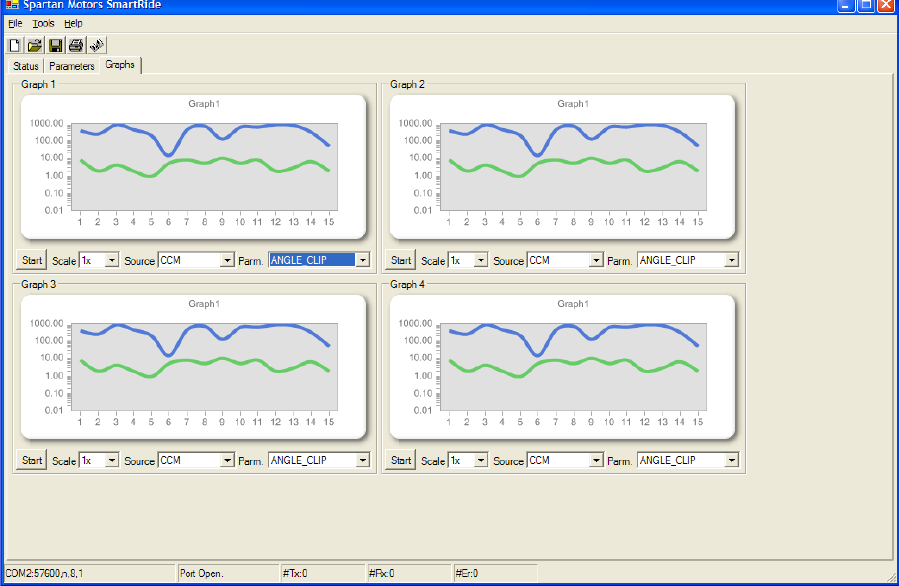
The ActiveRide main form was a single MDI window with three tabs that mapped to the three things a chassis engineer actually needed in the field: see what the modules are doing right now (Status), change the gains that govern how they react (Parameters), and watch the change take effect against the J1939 message stream (Graphs). The Status tab listed every algorithm and every diagnostic sensor with a checkbox column, and the Diagnostic Messages window let the operator initiate a check on demand — "the system will not perform scheduled checks; the operator must initiate the checks," per the manual. The Parameters tab is the spreadsheet that made the application worth installing: every active-suspension tuning parameter, six corners + Central, editable in place, with the change pushed live through the CCM the moment a new cell was clicked. The Graphs tab ran four independent line graphs side-by-side, each with its own Source / Parameter / Scale controls, so a benchmarking pass could correlate Sprung Natural Frequency against Roll, Pitch, and Load Compensation in real time over a logarithmic 0.01-to-1000 Y axis.

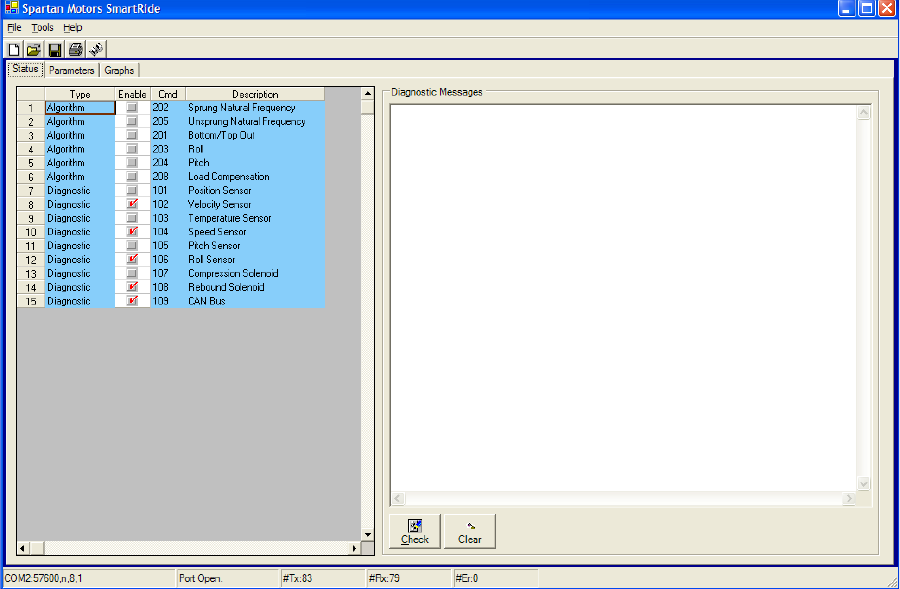
  • Status tab — sensors + algorithms, operator-initiated checksThe first tab lists every algorithm (Sprung Natural Frequency Cmd 202, Unsprung Natural Frequency 205, Bottom/Top Out 201, Roll 203, Pitch 204, Load Compensation 208) and every diagnostic sensor (Position 101, Velocity 102, Temperature 103, Speed 104, Pitch Sensor 105, Roll Sensor 106, Compression Solenoid 107, Rebound Solenoid 108, CAN Bus 109) with an Enable checkbox column. The Diagnostic Messages window on the right collects whatever errors the user-initiated Check button surfaces; each one must be cleared by hand as it's repaired.
  • Parameters tab — live tuning across all six corners + CentralThe marquee surface. Every editable active-suspension tuning parameter (the ANGLE_, GAIN_, K_, M_ parameter families) is laid out as a spreadsheet, with columns for Left Front, Right Front, Left Rear, Right Rear, Left Tag, Right Tag, and Central. White cells are editable; shaded cells are read-only; the Track column lets an engineer pin a parameter to a separate monitor window. The manual is explicit: "once a cell value is changed, and a new cell is clicked on, the change is sent through the CCM" — live recalibration, no flash, no reboot.
  • Graphs tab — four independent real-time streamsFour independent line-graph windows on a single tab, each with its own Source (CCM broadcast or any of the corner / tag modules), Parameter dropdown (any of the ANGLE_ / GAIN_ / K_ families), Scale (1×–5×), and Start / Stop control. Logarithmic Y axis from 0.01 to 1000.00, 15-sample rolling X axis, dual-trace overlay (blue and green) so the engineer could plot a setpoint against a measured response simultaneously. The four-pane layout meant Sprung Natural Frequency, Roll, Pitch, and Load Compensation could be benchmarked side-by-side on the road.
  • COM2:57600,n,8,1 — Dearborn Gryphon DPA III over RS-232Every main-screen screenshot carries the same status-bar callout at the bottom: "COM2:57600,n,8,1 · Port Open · #Tx:83 · #Rx:79 · #Er:0" — the live Tx/Rx packet counter that confirmed the J1939 link was healthy under load. Underneath was a Dearborn Group Gryphon DPA III adapter bridging the chassis's SAE J1939 (and J1708 where used) CAN bus to the operator workstation's RS-232 serial port. The SetupSerialPort form's SaxComm8 control wrapped the binary protocol (CreateCommandPacket / CreateAckPacket / CreateGetPacket / ProcessCommand) over the serial pipe.
  • Sentinel Pro USB key — copy protection + security levelActiveRide refused to launch without a Sentinel Pro USB security dongle plugged into the workstation. The same physical key carried the user's security level (None / View / Edit / Administrator), so a field-engineer key could observe and tune but only an administrator key could add users or rewrite the diagnostic-code or graph-code tables. The UsbKeyDiagnostics form ran a silent dongle check at startup and refused to bring the main form up if the key wasn't present.
  • Firmware Download — reflash all seven ECUs from one dialogA standalone dialog under Tools that picked an Intel HEX 8086 firmware file (CCMAPP.H86 for the CCM, REMAPP.H86 for the valve drivers — both visible in the source-tree binaries), let the operator choose Boot Code or Application Code, ticked any combination of the seven targets (CCM, Left Front, Right Front, Left Rear, Right Rear, Left Tag, Right Tag), and ran the download with a live progress bar. One application — every reflashable module on the chassis — bench-top or in-vehicle.

The application

Eleven Visual Basic 6.0 subsystems, one J1939 control plane, every suspension corner in one window.

The ActiveRide application was a Microsoft Visual Basic 6.0 MDI form suite that wrapped the engineer's entire active-suspension workflow into eleven discrete subsystems — from the Login dialog's security-level enforcement to the Firmware Download dialog's seven-target reflash. Underneath, every subsystem talked through a single packet protocol (CreateCommandPacket / CreateAckPacket / CreateGetPacket / ProcessCommand) over a SaxComm8 serial control, riding a Dearborn Group Gryphon DPA III bridge from the workstation's RS-232 port up onto the chassis's SAE J1939 / J1708 CAN network. The login screen reads "Spartan Motors SmartRide · Version 1.0.989.21728" — the customer-visible product name in front of Redmer Controls Inc.'s authorship.

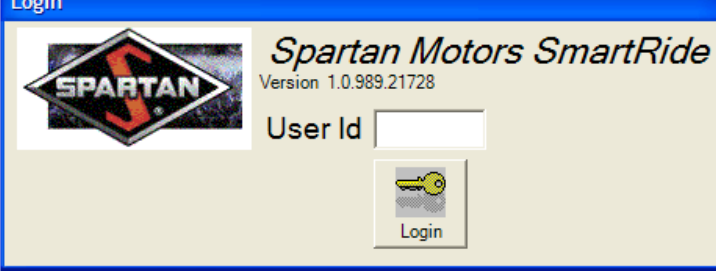
ActiveRide Login dialog from the manual's page 2 — Login title bar; black-and-red Spartan diamond logo on the left; "Spartan Motors SmartRide" italic wordmark and "Version 1.0.989.21728" version string at the top right; "User Id" label with an empty text-entry field; a gold-key Login button below.

Login — Spartan diamond + security-level enforcement

The Splash form was the launch surface: red-and-black Spartan diamond logo on the left, "Spartan Motors SmartRide" italic wordmark on the right with the version string "Version 1.0.989.21728", User Id text field, and a gold-key Login button. The User Id resolved to a security level (None, View, Edit, Administrator) — administrator only could change user-table entries. Per the manual: "the user identification establishes the security level of the user, which is set up within the program, in the User Administration screen, under the Tools Menu."
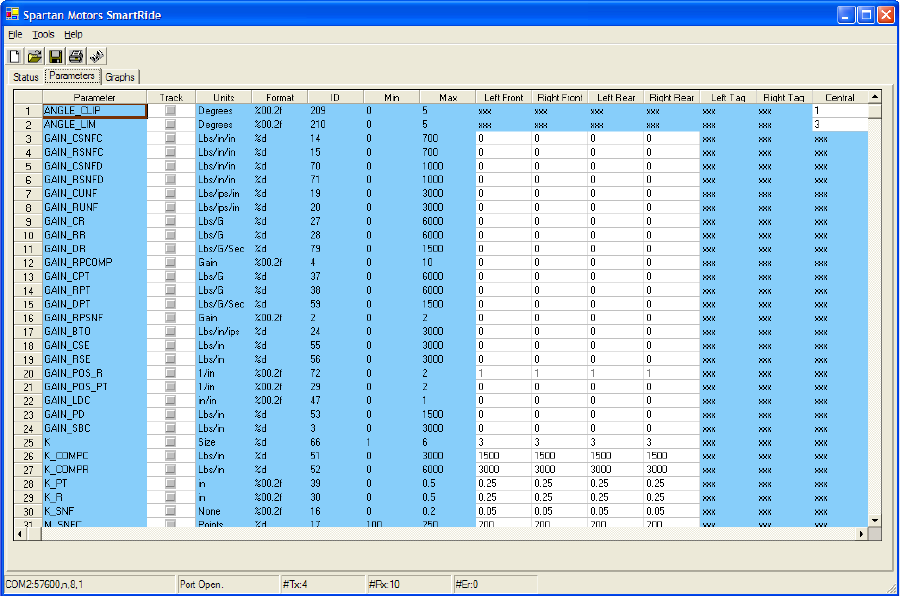
ActiveRide Parameters tab — "Spartan Motors SmartRide" title bar at the top; File / Tools / Help menu and toolbar; Status / Parameters / Graphs tab strip with Parameters selected. Editable spreadsheet of active-suspension parameters with Track checkbox column, Parameter / Units / Format / ID / Min / Max metadata columns, and per-corner Left Front / Right Front / Left Rear / Right Rear / Left Tag / Right Tag / Central value columns. Shaded cells read-only; white cells live-editable.

Parameters Tab — live tuning across six corners + Central

The MainForm's second tab. An editable spreadsheet of every active-suspension parameter: ANGLE_CLIP, ANGLE_LIM, the GAIN_ family (CSNFC, RSNFC, CSNFD, RSNFD, CUNF, RUNF, CR, RR, DR, RPCOMP, CPT, RPT, DPT, RPSNF, BTO, CSE, RSE, POS_R, POS_PT, LDC, PD, SBC), the K family (K, K_COMPC, K_COMPR, K_PT, K_R, K_SNF), the M family, and more. Columns: Track, Units, Format, ID, Min, Max, Left Front, Right Front, Left Rear, Right Rear, Left Tag, Right Tag, Central. White = editable, shaded = read-only; on cell-change the new value writes live through the CCM.

ActiveRide Status tab — Spartan Motors SmartRide title bar; Status tab selected. Left grid lists Algorithm rows (Cmd 202 Sprung Natural Frequency, 205 Unsprung Natural Frequency, 201 Bottom/Top Out, 203 Roll, 204 Pitch, 208 Load Compensation) and Diagnostic sensor rows (Cmd 101 Position Sensor, 102 Velocity Sensor, 103 Temperature Sensor, 104 Speed Sensor, 105 Pitch Sensor, 106 Roll Sensor, 107 Compression Solenoid, 108 Rebound Solenoid, 109 CAN Bus) each with an Enable checkbox. Diagnostic Messages window on the right with Check and Clear buttons at the bottom.

Status Tab — algorithms, sensors, on-demand diagnostics

The MainForm's first tab. Left panel: a grid of every Algorithm and every Diagnostic sensor (Sprung Natural Frequency, Unsprung Natural Frequency, Roll, Pitch, Bottom/Top Out, Load Compensation; Position, Velocity, Temperature, Speed, Pitch Sensor, Roll Sensor, Compression Solenoid, Rebound Solenoid, CAN Bus) with per-row Enable checkboxes. Right panel: the Diagnostic Messages window — user-initiated Check button at the bottom, individual Clear button per surfaced error. "The system will not perform scheduled checks; the operator must initiate the checks."

ActiveRide Graphs tab — Spartan Motors SmartRide chrome; Graphs tab selected. Four independent line-graph panels (Graph 1, Graph 2, Graph 3, Graph 4) in a 2×2 layout, each with its own Start button, Scale dropdown (1×), Source dropdown (CCM), and Parameter dropdown (ANGLE_CLIP shown). Logarithmic Y axis 0.01 → 1000.00; X axis 1–15 samples; dual-trace blue + green overlay. COM2:57600,n,8,1 / Port Open / #Tx:0 / #Rx:0 / #Er:0 status bar at the bottom.

Graphs Tab — four real-time scopes side-by-side

The MainForm's third tab. A 2×2 grid of four independent line-graph panels, each with its own Start button, Scale dropdown (1×–5×), Source dropdown (CCM or any specific module), and Parameter dropdown (any of the ANGLE_, GAIN_, K_ families). Y axis is logarithmic from 0.01 to 1000.00; X axis runs 1–15 rolling samples; dual-trace overlay (blue + green) so a measured value and a setpoint can be plotted simultaneously. The four-panel layout meant the operator could benchmark Sprung Natural Frequency, Roll, Pitch, and Load Compensation against each other on the road.

ActiveRide Firmware Download dialog — Firmware File group at the top with c:[Local Disk] dropdown and Dev / Rideware / COAST / Software / CCM / APP folder tree, CCMAPP.H86 highlighted in the file list. Type group on the right: Boot Code (selected) / Application Code radio buttons. Targets group at the bottom: numbered grid listing CCM (Select checked), Left Front, Right Front, Left Rear, Right Rear, Left Tag, Right Tag. Exit and Download action buttons + Download Progress bar at the foot.

Firmware Download — boot or application code, seven ECUs

A standalone dialog under Tools. Firmware File browser selects an Intel HEX 8086 binary (CCMAPP.H86 for the Central Control Module, REMAPP.H86 for the valve drivers); the Type radio group picks Boot Code or Application Code; the Targets grid lists the seven reflashable ECUs (CCM, Left Front, Right Front, Left Rear, Right Rear, Left Tag, Right Tag) with per-module Select checkboxes. Hit Download and the live Download Progress bar streams the binary out the serial pipe, through the Gryphon DPA III, across the J1939 bus, into the target module's flash.

Setup Users + Setup Diagnostic Codes + Setup Graph Codes

Three administrator-only setup dialogs under the Tools menu let an engineering lead curate the operator-facing surfaces. SetupUsers.frm maintained the User Id → Security Level mapping (None / View / Edit / Administrator). SetupDiagnosticCodes.frm let the lead define which Cmd codes (101–209 range) surfaced as which Diagnostic Messages and Algorithm names on the Status tab. SetupGraphCodes.frm defined the Source / Parameter / Scale choices populating the Graphs tab dropdowns. Underneath, Users.csv, DiagnosticCodes.csv, and Configuration.csv held the persisted state.

ActiveRide Login dialog — black-and-red Spartan diamond logo on the left; "Spartan Motors SmartRide" italic wordmark on the upper right with "Version 1.0.989.21728" beneath it; "User Id" text-entry field; gold-key Login button centered below. The customer-visible attribution and security-gate surface.

Spartan Motors · Redmer Controls · Dearborn Group

Built for the engineer doing benchmarking on the road.

ActiveRide was the calibration and firmware-download tool that let Spartan Motors's chassis-engineering team develop, benchmark, and qualify the SmartRide active-suspension platform across a multi-year product cycle. Redmer Controls Inc. wrote it as a Visual Basic 6.0 MDI suite of eleven subsystems on Windows 2000 / XP. Dearborn Group Inc.'s Gryphon DPA III bridged the J1939 / J1708 CAN bus to the workstation's RS-232 port. Spartan Motors deployed SmartRide under high-end Class A diesel-pusher motorhomes, fire and emergency apparatus, ambulances, and motorcoaches — coaches and trucks where ride quality on multi-axle, tag-equipped commercial chassis was the qualifying spec the entire product line was tuned around. Splash-screen attribution inside the shipped application: "Spartan Motors SmartRide · Version 1.0.989.21728 · (c) 1992-2002 Redmer Controls Inc."

Era
~2002–~2005
Partnership
Spartan Motors · Redmer Controls Inc. · Dearborn Group
ECU network
7 modules · J1939 over Gryphon DPA III · RS-232 57600 8-N-1
Calibration
Live parameter writes · 6 corners + Central · OTA reflash

Why this case study matters

The engineering-instrumentation case study from Redmer Controls Inc.'s automotive product line.

Operator-readable maintenance surfaces on every subsystem

Every operational surface in ActiveRide was designed for the engineer working from the jump seat or the bench: the Status tab's Algorithm / Diagnostic sensor list with per-row Enable, the Parameters tab's in-place spreadsheet edit, the Graphs tab's per-panel Source / Parameter / Scale controls, the Firmware Download dialog's per-module Select grid, the COM-port status bar's live Tx / Rx packet counter. Same engineering posture A1SI ships under today — every operator-facing maintenance window readable on the floor or in the vehicle, every change visible in one click.

Live recalibration without a flash-and-reboot cycle

The Parameters tab's defining feature: edit a cell, tab away, and the new value writes live through the CCM to the target module — no flash, no reboot, no lost test session. That instinct to keep the engineer in flow during a benchmarking pass runs through every controller A1SI has shipped since: DVP2's on-the-fly Paper Advance Settings, CVWS's in-flight Weighmaster threshold edits, EMDT's live device-state transitions on the production-floor unit.

Open integration with the standards every vehicle bus runs on

ActiveRide rode the SAE J1939 / J1708 standards that the heavy-duty truck and commercial-vehicle industry standardized on, bridged through the Dearborn Group Gryphon DPA III adapter that the same industry standardized on. No proprietary cable; no vendor-specific dongle on the chassis side; one open-standards stack from the workstation to the valve module. That commitment to open, vendor-neutral integration on the vehicle bus informs every A1SI product line today: CVWS's open-protocol Laumas CLM8, the Wireless Bridges line's RS-232 / Modbus RTU / PS-2 / Microsoft Serial Mouse coverage, EMDT's open device-scan ingest.

Need a calibration tool that drives every ECU on the bus from one window?

A1SI has been building production-floor and engineering-floor controllers since 1997 — DOS / FoxPro / Watcom-C on the Ford FN-145 seat testers, Visual Basic 6.0 on ActiveRide and DVP2, C# / .NET on the GM ATEC EPROM programmer, and Python + Django + React Native + embedded ESP32 / NVIDIA Jetson today. Same engineering posture across every era: live operator-editable parameter surfaces, savable diagnostic transcripts, open vehicle-bus integration through the standards the industry has settled on. If your chassis program needs a calibration tool that grows with the engineering workflow, we'd like to hear about it.

"Spartan Motors", "Spartan", "SmartRide", and the Spartan diamond logo are trademarks associated with Spartan Motors Chassis Inc. (Charlotte, MI); Spartan Motors's commercial-chassis lineage continues today under The Shyft Group / Spartan Fire and Emergency Vehicles. "Dearborn Group Inc.", "DPA", "Dearborn Protocol Adapter", and "Gryphon" are trademarks associated with Dearborn Group Inc. (Farmington Hills, MI). "CAN" is a trademark of Robert Bosch GmbH. "SAE J1939" and "J1708" are protocol designations of SAE International. "Microsoft", "Visual Basic", "Visual Studio", "Windows", "Windows 2000", "Windows XP", and ".NET" are trademarks of Microsoft Corporation. "Sentinel" and "Sentinel Pro" are trademarks associated with SafeNet / Thales Group. "Newmar" and "Mountain Aire" are trademarks of Newmar Corporation. "Fleetwood", "Discovery", "Bounder", "Pace Arrow", "American Eagle", "American Heritage", "Revolution", "Providence", and "Excursion" are trademarks associated with Fleetwood Enterprises Inc. The Newmar Mountain Aire hero photograph is by Greg Goebel, used under the Creative Commons Attribution-ShareAlike 2.0 Generic license (CC BY-SA 2.0) via Wikimedia Commons (file "Yvair_2b_(26403167936).jpg") — derivative use under this page inherits the CC BY-SA 2.0 obligation. The case study above describes engineering work performed by Redmer Controls Inc. (2001–2005), the predecessor business that informed the engineering posture A1 Systems Integrators (A1SI) ships under today, in a customer relationship with Spartan Motors Chassis Inc. The case study is preserved on this page as historical portfolio and pedigree — not as a currently shipping product offering. A1SI is not affiliated with or endorsed by Spartan Motors Chassis Inc., The Shyft Group, Spartan Fire and Emergency Vehicles, Dearborn Group Inc., Robert Bosch GmbH, SAE International, Microsoft Corporation, SafeNet, Thales Group, Newmar Corporation, Fleetwood Enterprises Inc., or any other named third party today; IP ownership of any deployed derivatives belongs to the respective program owners.