Redmer Software Company · 1998 · K–12 schools across the U.S. and Canada
The student image viewer that shipped to hundreds of schools.
EZ-VIEW combined a student information management system with a student photograph viewer in one Windows desktop application. The nation's largest School Photography Companies — including Olan Mills — purchased EZ-VIEW and distributed it to schools as part of their portrait packages. Teachers, librarians, counselors, and administrators in hundreds of K–12 schools across the United States and Canada used it from 1998 onward to find a student's record and their portrait in the same click.
Search a student, see their record and their portrait — instantly.
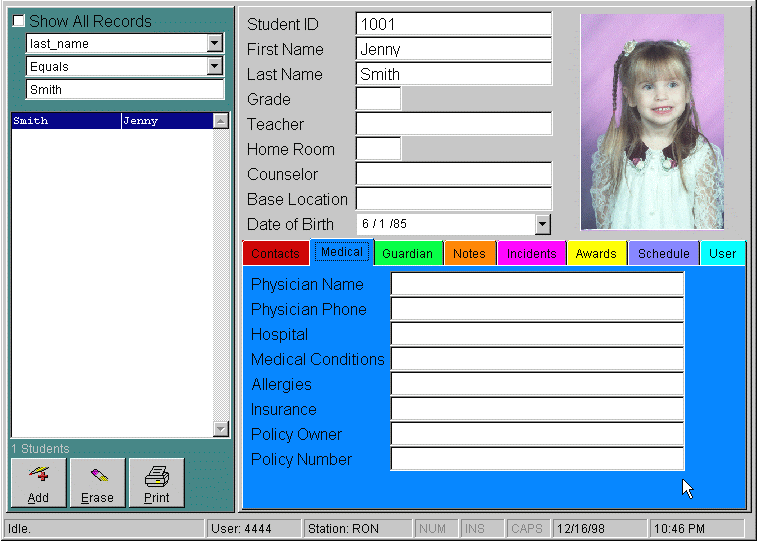
EZ-VIEW's main screen put the student record and the school portrait in the same view. The left pane carried a fast field-and-operator search (`last_name Equals Smith`); the center pane carried the full student record; the right pane carried the portrait pulled from disk in whichever of 60+ image formats the photography lab had shipped. Tabbed sub-sections (Contacts, Medical, Guardian, Notes, Incidents, Awards, Schedule, User) covered the rest of the record. The status bar in the screenshots — `User: 4444 · Station: RON · 12/16/98 · 10:46 PM` — preserves the actual era.
60+ image formats, including PhotoCDRead student photographs in Windows BMP, Adobe Photoshop, Truevision Targa, TIFF, Kodak PhotoCD, and more than 55 other formats. Critical because every school-photography lab shipped images in a slightly different file format — EZ-VIEW just opened them.
Multi-user across the school networkPhotos and records lived anywhere on the school network; teachers, librarians, counselors, and administrators all accessed EZ-VIEW concurrently from any workstation. No per-machine import, no proprietary photo store — drop the school's image folder anywhere on a share and the application found it.
xBase data files — open by designRecords stored in industry-standard xBase `.dbf` files rather than a proprietary blob. Schools could open the same files in Microsoft Access, FoxPro, Word, Excel, or Inprise / Borland dBASE — anywhere the xBase standard reached. Unusual for K–12 software of the era: zero data lock-in.
Report writer with wizard-driven layoutsBundled templates for student listings, detail reports, ID cards, and awards; a wizard-guided new-report flow that walked an administrator through layout, fields, filters, and grouping. Per the README, the only Student Image Viewer of the era to put wizards on report creation.
The full student record, in one formHomeroom, home address, guardian information, emergency contacts, medical conditions (physician, hospital, allergies, insurance, policy), awards, disciplinary actions, and class schedule — all tabbed into the same student record. The same data the front office needed to look up student records on paper in 1998.
Free with complete source codeDistributed openly to schools and to school computer-science programs. The README explicitly called out the application as a teaching tool for high-school programming-and-imaging instruction. Twenty years before "open source" was a default in K–12 software, EZ-VIEW shipped under that model.
A second Redmer Software product, shipping to hundreds of K–12 schools.
EZ-VIEW was Redmer Software Company's second product after EZ-SNAP. Where EZ-SNAP captured photo orders on a handheld at the studio, EZ-VIEW closed the loop: the finished portraits and the student records ended up at the school, accessible from every counselor's and administrator's workstation. The nation's largest School Photography Companies bought EZ-VIEW and shipped it to schools as part of their portrait packages, putting Redmer Software's engineering in front of a generation of K–12 educators.
Shipped by the nation's largest School Photography Companies
Olan Mills and other major U.S. and Canadian school-photography companies purchased EZ-VIEW and distributed it to schools as part of their portrait packages — the same customer base that EZ-SNAP served at the photo-session end of the workflow.
Hundreds of K–12 schools, U.S. and Canada
EZ-VIEW ran in hundreds of public and private K–12 schools across the United States and Canada from 1998 onward, on the workstations of teachers, librarians, counselors, and administrators — and on the lab machines in high-school computer-science programs that used it as a teaching example.
60+ photograph formats, in 1998
BMP, Adobe Photoshop, Truevision Targa, TIFF, Kodak PhotoCD — schools never had to think about which lab format their portrait company used because EZ-VIEW just opened it. A small piece of engineering that solved a very real K–12-front-office problem in the late-1990s.
xBase data, openly accessible
`.dbf` files in standard xBase format meant a school's IT staff could pull EZ-VIEW data into Excel, Access, FoxPro, Word, or any other xBase-aware tool. Unusual posture for K–12 software of the era; effectively a forerunner of today's open-data conventions.
Reports for the office, on demand
Bundled student-listing, detail, ID-card, and awards templates; a wizard for new reports. School administrators could generate the lists they needed without leaving the application or calling IT.
Open source, for the school CS lab
EZ-VIEW shipped with complete source code, freely available. School IT departments could install or customize it as needed; high-school CS teachers used the same source as a teaching artifact for desktop-application development and image-handling techniques.
A K–12 desktop application that scaled
Hundreds of schools, thousands of student records, one Windows desktop.
EZ-VIEW shipped from 1998 onward into K–12 schools across the United States and Canada, distributed through the same photographic-processing customers that purchased Redmer Software's other products. Built on Microsoft Visual FoxPro 6.0 Enterprise over the same open xBase data files that ran the rest of the Redmer Software product line; same engineering posture that carried forward into Redmer Controls Inc. (2001) and ultimately into A1SI today.
Era
1997–2000
Company
Redmer Software Company
Footprint
Hundreds of K–12 schools (U.S. + Canada)
Stack
Visual FoxPro 6.0 Enterprise · xBase .dbf
Why this case study matters
A K–12 desktop that bridged Redmer Software toward what came next.
A K-12 footprint that opened doors for everything after
EZ-VIEW put Redmer Software's engineering on the workstations of teachers, counselors, and administrators in hundreds of schools across two countries. That kind of distributed K–12 footprint is the trust signal a young software company needs to land the contracts that come next — and Redmer Software's evolution into Redmer Controls Inc. (2001) and the Ford / GM / BMW work that followed traces back through this product's field presence.
Built for non-technical school staff
EZ-VIEW had to be usable by a school librarian or guidance counselor who hadn't been to a software training. The search-and-show interface, the tabbed record, the wizard-driven report builder — all of it was tuned for the user who needed to look up a student and print a list, not the user who wanted to write SQL. The same operator-first posture that powered EZ-SNAP on the studio floor.
Open data, by intentional design
Records lived in industry-standard xBase `.dbf` files; the application shipped with complete source code; schools could pull EZ-VIEW data into any xBase-aware tool. Zero data lock-in was an unusual posture for late-1990s K–12 software, and it preceded today's open-data and open-source conventions by twenty years. The same instinct underwrites A1SI's current preference for open protocols (Modbus, Nordic UART Service, PS/2 Set 2, REST) across the product line.
Need a desktop app that ships to thousands of non-technical users?
A1SI has been building software for non-technical operators since 1997 — from school administrators on K–12 workstations to plant-floor line workers, EMS field medics, and commercial-vehicle weighmasters. Same engineering posture, modern stacks (React Native, Python, C#, embedded ESP32 / NVIDIA Jetson). If your audience needs a UI that just works, we'd like to hear about it.
"Olan Mills" is a trademark associated with the Olan Mills Studios brand (acquired by Lifetouch / Shutterfly in 2011). "Microsoft", "Windows", "Visual FoxPro", "FoxPro", "Access", "Excel", and "Word" are trademarks of Microsoft Corporation. "Adobe" and "Photoshop" are trademarks of Adobe Inc. "Kodak" and "PhotoCD" are trademarks of the Eastman Kodak Company. "TIFF" / "Truevision Targa" / xBase / "dBASE" are trademarks of their respective owners. "Inprise" / "Borland" were trademarks of Borland International Inc. / Inprise Corporation at the time and are currently held by their respective successors. The case study above describes engineering work performed by Redmer Software Company (1997–2001), the predecessor business that informed the engineering posture A1 Systems Integrators (A1SI) ships under today. The case study is preserved on this page as historical portfolio and pedigree — not as a currently shipping product offering. A1SI is not affiliated with or endorsed by Olan Mills, Lifetouch, Shutterfly, Adobe, Microsoft, Kodak, or any other named third party today; IP ownership of any deployed derivatives belongs to the respective program owners.